23rd March 2026
Village Halls Week provides an important opportunity to recognise the vital role that village halls play in supporting the health and wellbeing of local communities. Community access defibrillators can further enhance this role by providing potentially life-saving assistance for residents and visitors while emergency services are on their way. :contentReference[oaicite:0]
Having a community defibrillator located at a village hall helps ensure that emergency equipment is available 24 hours a day, seven days a week. To maximise effectiveness, defibrillators should be installed in a central, accessible location, ideally on an external wall close to the main entrance. Heated cabinets are recommended to protect batteries and pads from cold temperatures, and a continuous electricity supply is required. :contentReference[oaicite:1]
While some cabinets may be locked in higher-risk locations, unlocked units are generally preferred because they allow immediate access during an emergency. Regular maintenance is also essential, and village halls are encouraged to nominate a volunteer guardian responsible for checking the equipment remains clean, functional and ready for use. All public access defibrillators should be registered with The Circuit, the national defibrillator network, ensuring emergency services can direct callers to the nearest available device. :contentReference[oaicite:2]
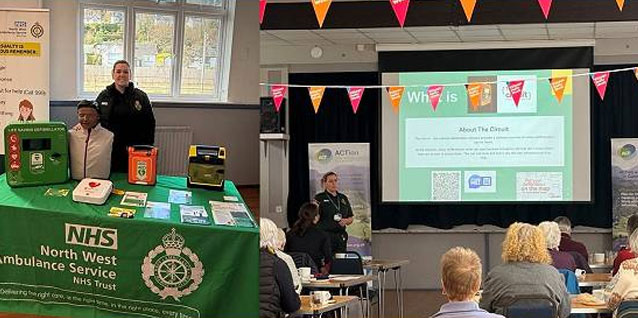
On 14th March, Megan Stephenson, Community Resuscitation Engagement Officer for Cumbria at North West Ambulance Service (NWAS), attended ACT's Village Halls Week celebration event at Braithwaite Institute. Megan spoke about the importance of community defibrillators in rural areas and highlighted the support available to village halls interested in improving emergency preparedness. :contentReference[oaicite:3]
Megan also promoted the free CPR awareness sessions available to village halls across Cumbria. While no formal training is required to use a defibrillator, these sessions help build confidence in performing CPR and using an Automated External Defibrillator (AED) effectively. Sessions typically last around 90 minutes and can be arranged at a convenient time by dedicated CPR trainers. :contentReference[oaicite:4]
To arrange a CPR awareness session, contact:
For more information about The Circuit national defibrillator network, visit:
Village Halls Week 2026 ran from Monday 16th March to Sunday 22nd March and celebrated the important contribution that village halls make to the health, wellbeing and resilience of rural communities. :contentReference[oaicite:5]