
4th February 2026
We are updating this page with information from each of the Community Inquiry sessions as they are delivered. You can see our journey from recruitment to recommendations and working with stakeholders if you read from top to bottom.
_____________
Above Derwent, Borrowdale, Buttermere, and Keswick Community Inquiry
Do you live or work in Above Derwent, Borrowdale, Buttermere, or Keswick Parish?
You could be one of 25 people selected to take part in a Community Inquiry discussing these important questions:
Is this a good place to live and work? How could it be better?
A Community Inquiry is about local people taking power and shaping the future of their area. Together, you will identify the issues that matter to you, develop action plans, and share your recommendations directly with the relevant authorities. This Inquiry is being organised by ACTion with Communities in Cumbria, Cumbria’s rural development charity, but is led by you.
Some key details:
- The Inquiry will involve 8-10 sessions from 15th April to 24th June 2026, mostly Wednesday evenings, but including two Saturdays. Exact dates are provided below.
- If you attend all sessions, you will receive £500 in vouchers.
- We want everyone to be able to attend. We can help if you have needs such as childcare, carer’s costs, or difficulties with travel that make it harder to take part.
We have answered some questions you may have about the Inquiry on this document: Community Inquiry Questions. If you would like any further information, you can contact communityinquiry@cumbriaaction.org.uk or call 07836 405287 during office hours.
To register your interest go to www.sortition.uk/cumbria or scan the QR code below. (Removed 29.04.26)
The deadline to register is 5pm Sunday 8th March 2026.
Taking part in this Community Inquiry gives you the chance to help shape the future of where you live and to have your voice heard. We hope to see you there.
_____________
Session 1 Introducing the process: Wednesday April 15th 7-9pm
This session was about introducing the group to ACT, each other, and the Community Inquiry process. Activities during the session included:
- Welcome and Introduction
- Who ACT are, why we are doing the Inquiry, and information on the National Lottery Community Power pilot.
- Information on the Inquiry process and what to expect.
- Thinking about the ‘art of the possible’ and what could be achieved through this Inquiry. We had two brief presentations to introduce the context and opportunity of the Community Inquiry:
- Michael Barry, Assistant Director of Thriving Places at Cumberland Council spoke about how Cumberland Council would like to work with the Inquiry. This was followed by a short Q & A session.
- Sally Clarke, a member of the Cumbria Climate Change Assembly (2025) shared her experience of a Citizens’ Assembly, what she got out of the process, and what Citizens’ Assembly members are still working on together. A short Q & A session followed.
Reflections on what motivated group members to join the Inquiry were captured.
Session 2 Priority setting: Saturday April 18th 10am-3pm
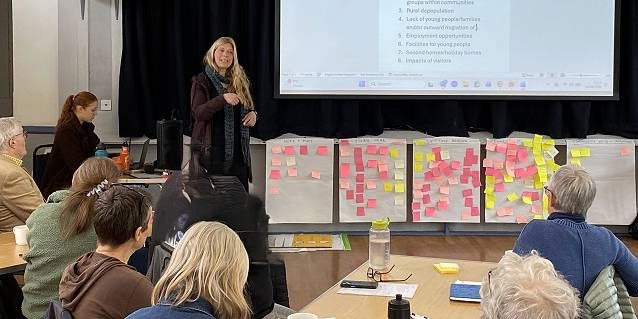
Session 2 did not have any external contributors as the focus was on identifying the themes, or priority areas, the Inquiry would focus on. The Group engaged in a number of activities to pin down their priority areas and begin to articulate some of the issues they would like to learn more about and address. There is a great deal of love for the area, amongst this group, and people care deeply about protecting the Lake District landscape.
This was a full-day session which involved:
- Using maps to help identify the shared positives and challenges about where they live.
- Reflecting on the mapping activity and expanding discussions on the positives and challenges beyond the physical place to include areas such as work and leisure, community voice and inclusion, travel and transport, housing, crime, services, environment, and green spaces.
- Establishing and agreeing a set of four priority areas to focus on during the Inquiry.
- Starting to think about some of the issues, and the causes of these issues, which may be contained within a specific priority area through constructing problem trees.
- Visioning what a positive future could look like here, including who and what is needed to make that vision happen.
This is part of one of the completed problem trees.
The particular areas identified for further discussion are:
- Rural depopulation: This priority area encompasses issues which may lead to people, particularly young people/families, moving out of the area such as affordability/availability of housing, lack of amenities, and employment opportunities.
- Transport, travel, and highways: This includes issues such as traffic management and a lack of/limited/unreliable bus services.
- Climate and environment: This priority area includes issues around flooding, farming, and nature.
- Impacts of visitors: This includes issues around damaging environmental activities by some visitors, but also housing availability, transport provision, perpetual low paid jobs and a question about economic benefit.
Recommendations may be made through this process, which seek to address some of these challenges.
The group chose by a show of hands to focus the next conversation on the questions around transport, travel and highways. They made suggestions about the range of people and organisations they would like to hear from to help grow their understanding of the issues and opportunities.
Session 3 Transport, Travel & Highways: Wednesday April 22nd 7-9pm
Session 3 focused on the priority area of transport, travel, and highways. Three commentators were invited to the session, each providing a short presentation. Inquiry members were then able to raise questions with all of the commentators creating the opportunity for more depth discussion of particular areas.
Recordings of each presentation is available below. Many thanks to the commentators for their contributions to the session:
- Roger Clarke (Hope Valley Climate Action) spoke about the ‘mini Switzerland’ approach: a funded £12million demonstrator to create a Swiss-style integrated public transport network in the Peak District.
- Alistair Kirkbride (Low Carbon Destinations) talked about Transport for the Lake District and understanding carrying capacity in each place, to develop appropriate solutions.
- Karl Melville (Assistant Director for Highways and Transport, Cumberland Council) gave an overview of how the Council plans and responds to maintenance needs on the highways. He also spoke about parking restrictions and enforcement.
Further to questions, participants were encouraged to make a note of what they would particularly like to hold on to from everything they heard from the commentators.
Session 4 Climate and Environment: Wednesday April 29th 7-9pm
This session was focused on the priority area of climate and environment. Three commentators spoke at the session, covering issues including flooding, farming, and conservation. Group members than had the opportunity to put questions to the speakers on issues which they would like to gain a deeper understanding or knowledge of.
Recordings of each of the presentations, and any accompanying slides, are available below. Thank you to the speakers who contributed to this session:
- Angela Wakefield (Environment Agency, Catchment co-ordinator)
- Bethany Berry-Henshaw (West Cumbria Rivers Trust, Cocker Management Group)
- Maddy & Danny Teasdale (Ullswater Catchment Management CIC)
Angela Wakefield Slides
Community Inquiry EA Angela Wakefield
Bethany Berry-Henshaw Slides
Maddy and Danny Teasdale Slides
Session 5 Visioning & Power: Wednesday May 6th 7-9pm
In Session 5, the Group took a break from commentator inputs and spent some time focusing on where their work is taking them. Activities included:
- Constructing a draft ‘vision statement’ which outlines the Group’s vision for their area. Aspirations for their place, opportunities, and challenges, were written down and used to build an overarching statement. This statement will continue to be developed over the course of the Inquiry and the final version will be included at the start of the final report.
- Thinking about local power structures: the Group were introduced to Government structures at a local and national level and spent time thinking about how they may frame recommendations towards those who have influence over the issue raised in that recommendation.
Session 6 Impact of Visitors: Wednesday May 13th 7-9pm
This session was focused on the priority area of the Impacts of Visitors. Three commentators spoke at the session each offering different perspectives on the impact of visitors from community-led approaches right through to the work of strategy groups.
Topics discussed included second homes, visitor levies, public space protection orders, and promoting respect for the wider countryside/landscape. Group members then engaged in a Q&A with the commentators which provided the opportunity to expand on anything they had heard.
Recordings of each of the presentations, and any accompanying slides, are available below. Thank you to the speakers who contributed to this session:
- Michael Hill (CEO, Friends of the Lake District)
- Peter Walter (Member, Lake District National Park)
- Georgina Wrathall (Wasdale Action Group CIO)
Note. Due to connection issues, Michael turned his video off during his presentation. This section has been edited to cut out where we requested that he do this. None of his input has been altered or cut down in any way.
Peter Walter slides
Session 7 Rural Depopulation: Wednesday May 20th 7-9pm
The Inquiry identified the loss of young people as a particular challenge – young people finding it hard to stay or settle in this area because of inflated house prices and a shortage of affordable homes to rent, alongside a lack of well paid career prospects and opportunities. Our commentator inputs helped to explore the housing situation further and suggested policy solutions and practical community actions that might help.
Many thanks to contributors:
- Chloe Swift (Strategy Planner for Lake District National Park Authority)
- Louise Dunn (Chair of Keswick Town Council)
- Benita Lapthorne and Peter Toes (Secretary and Chair of Keswick Community Housing Trust)
Video recordings of the three inputs are included below along with accompanying slides.